Zen Druidry
Zen Druidry was first coined by Isaac Bonewits in the 1970s to refer to a group of reformed Druids in America. There is no indication that Bonewits ever underwent any formal Zen training.
To clarify any confusion therefore, Zen distinguishes itself from other forms of Buddhism in that it invites us to follow the path of Bodhidharma in a teaching outside the Sutras, an intimate heart practice. Essentially this constitutes: koan practice with a teacher, and zazen or shikantaza - just sitting. Zen is a 'religion' of Nothing. It only means: Clear Mind, the 'Mind of a Child'.
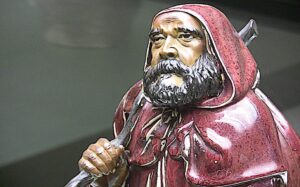
Bodhidharma
If the heart of Zen is clarity of the mind, shamanic skills address our emotional landscape, free from any Eastern behavioural requirements. Druidry, within the terms of Zen Druidry, is down-to-earth and practical. It includes the psychological balance of learners, something both traditional Zen schools and Western Christian monasteries tend to skirt around.
The Druids were learned spiritual elders who simply sought to understand the truth of the world around them. Druids were judges, poets and priests all rolled into one. For the inner path of the Druid, I refer you to the Priesthood page. Interestingly, Bodhidharma was described simply as a wanderer, even as a red-haired deacon from Persia.
To sum up, Zen Druidry covers the core practice of Zen schools, without the monastic rules of those schools. It avoids the 'stink of Zen'. A path of direct experience, via both formless meditation and shamanic skills, it helps to guide individuals working with the mind. Under guidance from an anam cara or soul-friend.
Historical essence of Zen
In 527 CE, Bodhidharma, the legendary Indian monk credited with bringing Chan (Zen) Buddhism to China, arrived at the court of Emperor Wu of Liang. The emperor was renowned as Buddhism’s greatest patron in China. He had built countless temples, ordained thousands of monks, copied scriptures, and supported the sangha with imperial resources. He considered himself the foremost Buddhist in the land and expected praise and recognition from this renowned master from India. Emperor Wu: “I have built many temples, copied sacred texts, and supported countless monks. What merit have I accumulated?”
Bodhidharma: “No merit whatsoever.”
Emperor Wu (shocked): “How can you say that? I have devoted my life and empire’s resources to supporting the Dharma! Surely such actions create immense merit?”
Bodhidharma: “All these are inferior works, the shadows of merit, following you like shadows follow form. Although they appear to exist, they are nothing more than illusions. True merit is found in pure wisdom and the perfect union of stillness and awareness. Its substance is empty and serene. Such merit cannot be sought through worldly actions.”
Emperor Wu: “Then what is the highest meaning of the noble truth?”
Bodhidharma: “Vast emptiness, nothing noble.”
Emperor Wu: “Who is it that stands before me saying these things?”
Bodhidharma: “I don’t know.” The emperor, unable to understand Bodhidharma’s meaning, could not establish rapport with him. Recognizing that the emperor was not ready for his teaching, Bodhidharma left the palace. He crossed the Yangtze River and went north.
For more details contact: peers.esq@gmail.com